



You might remember the slap of bare feet on cold kitchen tile, the microwave clock stuck at 6:12 a.m., your small hands folding napkins into lunch bags because a parent couldn’t get up after another night of tears. Later, at school, you finished your best friend’s worksheet—not because you loved math, but because solving other people’s problems had already become muscle memory. Many readers tell me they grew up “the responsible one,” and I’ve sat across from enough of them to say it plainly: there’s a word for this. Parentification. Naming it is not blame; it’s the first honest door into relief.
Key Takeaways
- Parentification is a role reversal where children take on adult responsibilities—instrumental, emotional, or both.
- Chronic and especially emotional parentification can mirror neglect and shape stress responses, attachment, and health over time.
- Healing focuses on balance: self-compassion, boundaries, grief work, mindful presence, reciprocal relationships, and solid basics.
- Expert-informed strategies and therapy can rewire safety and ease into daily life; perfectionism and over-functioning can soften.
- Loyalty and cultural values can coexist with limits; love with edges protects everyone.
What is parentification?
Parentification is a role reversal: a child assumes responsibilities that belong to the adult—practical, emotional, or both. The American Psychological Association calls it “the reversal of the parent–child roles, where the child assumes responsibilities typically handled by the parent.” On the ground, that can mean cooking, corralling siblings, translating for immigrant parents, budgeting, or serving as a confidant, referee, or therapist for the adults at home.
“Parentification asks a child to carry a load their nervous system and sense of self aren’t built to carry yet. It can create micro-successes—‘Look how capable you are!’—while quietly stealing the experiences that wire safety, play, and ease into the developing brain.”
— Dr. Sarah Chen, Clinical Psychologist, NYU
In my experience, that paradox—the gold star that hides the cost—is the tell.
Two forms of parentification
- Instrumental parentification: The child handles concrete tasks—childcare, budgeting, errands, managing appointments. Many former “eldest daughters” recognize this pattern immediately. It builds skills; it also sets a trap if no one hands those duties back.
- Emotional parentification: The child becomes a parent’s confidant or regulator—soothing rage, absorbing secrets, reassuring a caretaker after fights, crises, or depressive spells. This is the quieter wound, and arguably the one that lingers the longest.
Sometimes these roles are time-limited and buffered by warmth; children may stretch and thrive. But chronic parentification—especially the emotional kind—functions like neglect: a child is deprived of care while being conscripted to provide it. That contradiction leaves a mark.
How parentification takes root
This pattern often germinates in households under strain: illness, addiction, mental health challenges, single parenting without support, immigration pressures, poverty, or intimate partner violence. The CDC’s long-running research on Adverse Childhood Experiences (ACEs) notes that 61% of adults report at least one ACE, and 1 in 6 report four or more—early adversities linked with increased risk for mental and physical health problems across the lifespan (CDC). Parentification isn’t listed on the ACEs survey, but it frequently travels with those stressors. When a parent is consumed by survival, the child becomes the glue. From what I’ve seen, children do not volunteer for that role; they inherit it.
Why this matters to the body and brain
Developing brains depend on “serve-and-return” moments—those back-and-forth nudges of attention that say, “You’re safe. You matter.” Without enough of those exchanges, or under unrelenting stress, the body can shift into what Harvard’s Center on the Developing Child has termed “toxic stress”: prolonged activation of the stress response without adequate buffering from supportive adults (Harvard University). Over time, attention, emotion regulation, and even immune function are shaped by that load. If you grew up hyper-alert, scanning for danger, that wasn’t personality—it was biology doing its best.
Parentification in everyday life: how it shows up now
- You over-function. At work, among friends, at home—you’re the dependable one. When others drop the ball, you catch it. Then you quietly set the table, again.
- Rest feels risky. Sitting down is not ease; it’s static. You may feel you have to earn belonging with usefulness.
- You read the room with eerie accuracy. Voices lower. Bodies tense. You see it, you pivot. Your own needs? Easy to miss.
- Receiving care is uncomfortable. Compliments slide off. Offers of help trip alarms. It’s safer to give than to need.
- You turn into the therapist. Partners, bosses, siblings—people bring you their storms, and you manage the weather.
- You burn out in loops. Push, perform, drop, recover, repeat. The small things feel enormous the day after you crash.
There’s science beneath those habits. Chronic duty and vigilance strengthen neural pathways that prioritize external signals and mute internal ones. The system equates “doing” with safety. Sustained cortisol and adrenaline can fuel anxiety, sleep disruption, and health issues (NIMH). Perfectionism—so often praised—is not neutral either; Harvard Health has reported links between perfectionism and elevated risk for anxiety and depression. My take: perfectionism kept you afloat, until it didn’t.
A real-world snapshot
When Maya, 28, finalized her divorce last fall, she realized she had never actually been partnered—she had been parenting. Her mother had confided every adult fear in her, so Maya became a master caretaker early. In marriage, she did the taxes, booked travel, prodded therapy appointments, and edited late-night graduate essays. When she finally asked for backup, her husband called her “controlling.” In therapy, a counselor named the pattern: parentification. “Hearing the word felt like a key turning,” she told me. “I could stop being the fixer and see what love looked like without a job description.”
Emotional parentification: the hidden ache
Emotional parentification is especially confusing because it masquerades as closeness. A parent saying, “You’re the only one who understands me,” lands like love. Inside, though, a child learns: love = self-abandonment. That lesson calcifies.
“When a child becomes the container for an adult’s feelings, the child’s feelings have nowhere to go. Healing means giving those exiled parts a home again—inside you, with support.”
— Dr. Miguel Alvarez, Family Therapist and Researcher (Harvard-affiliated clinic)
I’ve seen adults grieve hardest here—not the chores, but the intimacy that cost them their own center.
What parentification is not
- It’s not your fault. You adapted to conditions you did not choose.
- It’s not a simple morality tale about your caregivers. Many were doing the best they could. Impact still matters.
- It’s not a life sentence. Brains change. Relationships repair. With help, patterns can soften.
Inner Child Healing Guide for Parentification: why these steps work
Healing parentification isn’t about blame; it’s about balance. You’re learning to be cared for as much as you care for others. The arc below reflects what I’ve seen help over time—evidence-informed, yes, and also field-tested in messy, real lives.
-
1) Name, map, and validate the pattern
Why it works: Clear language organizes scattered memories and interrupts self-blame. Validation lowers shame—a gatekeeper in nervous-system repair.
How to try it:
- Draft a brief timeline of caregiving from childhood. Note your age, what you did, and what you felt.
- Circle the moments where you needed support and gave it instead.
- Say aloud: “I didn’t fail. I adapted. That pattern has a name—parentification.”
-
2) Practice self-compassion like it’s a daily vitamin
Why it works: Research summarized by the American Psychological Association links self-compassion to lower anxiety and depression and better resilience (APA). For the parentified child, warmth toward yourself is the corrective dose you missed then.
How to try it:
- Use a three-step pause: Notice the struggle; name it (“This is stress”); add kindness (“May I be gentle with myself right now.”).
- Hand on chest. Long exhale. Use the tone you needed at eight, not the tone you learned at eighteen.
-
3) Rebuild “serve-and-return” inside your life
Why it works: Brains thrive on responsive care. You can recreate that rhythm with yourself and safe others (Harvard University).
How to try it:
- Choose one daily ritual: Ask, “Body, what would help?” Answer it: “Water and a five-minute stretch.”
- With trusted friends, make small asks: “Could you text me after my interview?” Receive their yes without minimizing.
Pro Tip: Anchor a two-minute self check-in to an existing cue (e.g., after brushing teeth). Pairing new care with a familiar routine helps it stick. -
4) Set boundaries that reduce emotional parentification today
Why it works: Clear limits lower ambient stress and re-teach safety. When you stop being the family therapist, your system can finally downshift.
How to try it:
- Script phrases: “I care about you. I’m not able to be your only support. Let’s look at other resources.”
- If a parent overshares: “That sounds hard. I’m not the right person to hold this. Could you bring it to your counselor?”
Pro Tip: Write your boundary scripts on a notes app or card. Read them verbatim in the moment—consistency beats improvisation when emotions run high. -
5) Grieve the childhood you didn’t get
Why it works: Grief metabolizes the frozen energy of “I had to be big when I was small.” Without it, we recreate parentification to outrun loss.
How to try it:
- Letter from your younger self: “Here’s what I carried.” Reply as your adult self: “I’m here now. You won’t carry it alone.”
- Try expressive writing; there’s documented benefit in processing feeling on the page (APA). In my files, grief letters change people more than they expect.
-
6) Reparent the inner child with consistent micro-care
Why it works: Predictable, nurturing routines signal safety. Over time, your body learns rest isn’t danger in disguise.
How to try it:
- Morning: three slow breaths, hand to heart; one intention—“Today I will not abandon myself.”
- Midday: five minutes of light, air, or gentle movement.
- Evening: screen-free wind-down; remind yourself, “Doing less can be safe.”
-
7) Practice mindful presence to unhook the fixer reflex
Why it works: Mindfulness reduces reactivity and strengthens attention to internal cues (NCCIH). It also creates a beat of choice between urge and action.
How to try it:
- Before you jump in, ask: “Is this mine?” If not, imagine setting down a heavy backpack.
- Two-minute noticing: feel your feet, name five sounds, unclench your jaw.
-
8) Build reciprocal relationships and let yourself be helped
Why it works: Social support buffers stress and improves health outcomes (NIH). Parentification taught one-way giving; healing requires two-way care.
How to try it:
- Practice “small asks” and track the evidence that help arrives.
- Notice the impulse to decline support; experiment with “Yes, thank you.”
-
9) Therapy that targets parentification patterns
Why it works: Trauma-informed therapies offer structure for healing attachment wounds, renegotiating boundaries, and processing stored stress. Psychotherapy’s effectiveness is well-supported (APA).
How to try it:
- Seek clinicians versed in childhood emotional neglect, attachment, or family systems. Name parentification as your focus.
- Consider group therapy to practice balanced relating in real time.
-
10) Protect the basics: sleep, nourishment, movement
Why it works: A depleted body won’t feel safe enough to receive care. Stress management lands best alongside steady routines (NIMH). You can’t reparent your inner child on crumbs.
How to try it:
- Treat bedtime like a promise to your younger self.
- Choose movement that feels like play, not penance.
- Eat at regular intervals so adrenaline isn’t your primary fuel.
Expert wisdom to keep nearby
“Boundaries are not walls; they are doors with doorknobs on your side. Each no creates space for a deeper, truer yes.”
— Jasmine Patel, LCSW
“Perfectionism was a survival strategy in parentification. You can thank it for keeping you safe—and still choose something softer now.”
— Dr. Sarah Chen, Clinical Psychologist, NYU
“Grief is love’s echo. If you hear it, it means your love is intact.”
— Dr. Miguel Alvarez, Family Therapist and Researcher
What about loyalty and love for your family?
Loyalty and love can coexist with limits. You can care for your parents and refuse emotional parentification. You can send groceries and decline to be their therapist. You can visit and still end a visit when your boundaries are crossed. You can honor what your caregivers survived and protect your own nervous system. That’s adult love—love with edges. My view: boundaries are a form of respect for everyone involved.
For immigrant, eldest, or marginalized readers
Parentification often intersects with culture, gender, and migration. Maybe you translated at medical appointments, or you swallowed racism at school so your siblings wouldn’t have to. Those were heavy loads. Your strength is real, and so is the fatigue. Healing doesn’t mean discarding your community’s values; it means refusing to sacrifice your well-being to uphold them alone. In the UK, charities talk about “young carers” by the hundreds of thousands—proof that this story is bigger than any one family. Reciprocity and rest belong to you, too.
If this sounds familiar, you’re not alone
The World Health Organization estimates that 1 in 8 people worldwide live with a mental disorder (WHO). Many are carrying the shadow of parentification without a word for it—high-functioning, deeply tired, admired for resilience, quietly lonely. I meet them in clinics, classrooms, and boardrooms. A final note I believe: the traits that got you here don’t have to be the same ones that carry you forward.
A gentle experiment for this week
- Pick one place you usually over-function. Create a 10% reduction. If you write the team agenda, ask a colleague to draft the first pass. If you’re the family reminder system, set up shared reminders and step back.
- When anxiety spikes, name it: “This is the old parentification alarm. It thinks I’m unsafe. I’m allowed to rest.”
- Afterward, write three sentences to your younger self: what changed, how it felt, one thing you’ll try next time.
Image: watercolor of an adult comforting their younger self, journaling about parentification under a soft lamp
The long game
Healing parentification is not a sprint. It’s a slow re-education of body and mind. Choosing the awkward pause over the automatic yes. Telling the truth sooner. Letting people see you when you’re not endlessly competent. Building a life where care is mutual—and your inner child finally gets to play. You’re not broken. You adapted. And now you’re allowed to adapt again, toward a life where responsibility doesn’t erase your needs and love doesn’t ask you to disappear.
About the author’s lens
At InnerRoots, we speak to the part of you that kept going. Not because it was easy, but because stopping didn’t feel like an option. As you work this guide, keep listening for the smallest yes in your body. Follow it. That’s the sound of your life returning.
The Bottom Line
Parentification names a real burden—and shows you where to begin again. With compassion, boundaries, grief, mindful pauses, reciprocal support, and steady basics, you can rewire for safety and ease. Love can have edges. Care can include you.
References
- American Psychological Association (APA) Dictionary of Psychology
- Centers for Disease Control and Prevention (CDC): Preventing Adverse Childhood Experiences (ACEs)
- Harvard University: Center on the Developing Child — Toxic Stress
- Harvard University: Center on the Developing Child — Serve and Return
- National Institute of Mental Health (NIMH): 5 Things You Should Know About Stress
- Harvard Health Publishing: When the pursuit of health is harmful (perfectionism and mental health)
- American Psychological Association (APA): The power of self-compassion
- American Psychological Association (APA): Writing to heal
- National Center for Complementary and Integrative Health (NCCIH): Mindfulness Meditation
- National Institutes of Health (NIH): Social Relationships and Health (review)
- World Health Organization (WHO): Mental disorders fact sheet
Summary and next step
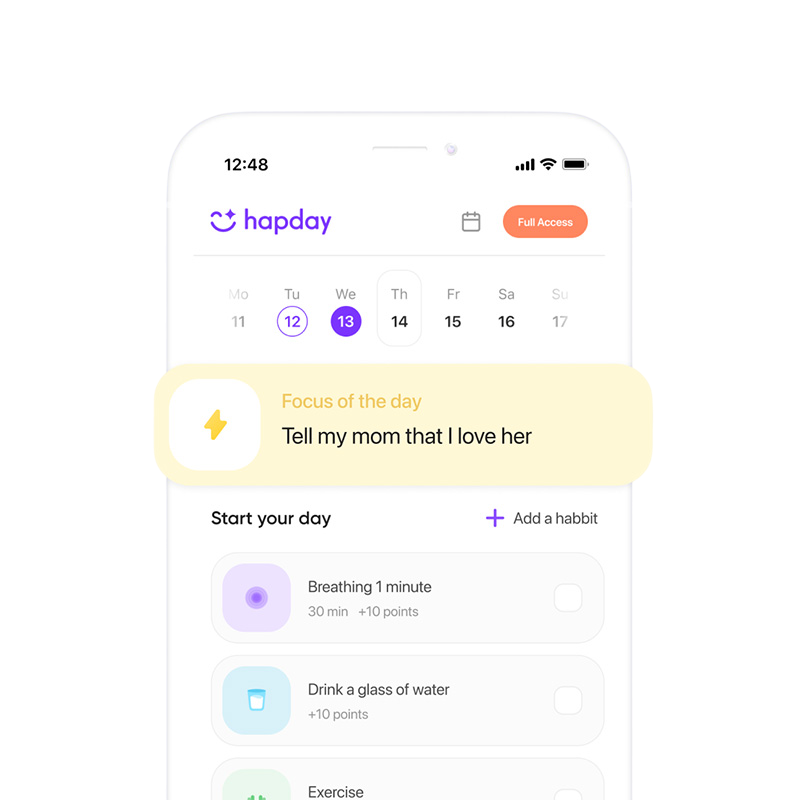
Parentification names a real burden: being the fixer, peacemaker, and parent long before you should’ve been. With science-backed tools—self-compassion, boundaries, grief work, mindful presence, and reciprocal relationships—you can reparent your inner child and build a life that cares for you back. You don’t have to do it alone.
Get daily support and guided practices to heal from parentification with Hapday: https://hapday.me/