



Table of Contents
- Introduction
- The Invisible Bridge: How Childhood Trust Gets Built
- When the Bridge Cracks: What Early Wounds Teach Your Nervous System
- What Trust Issues Look Like in Adult Life
- Why Your Trust Issues Need Inner Child Healing
- The Science Behind Inner Child Work
- Inner Child Healing in Practice: Where to Begin
- What Makes Inner Child Healing Uniquely Powerful for Trust
- When Trust Was Broken Not Once, But Every Day
- Practical Scripts for Everyday Trust Repairs
- A Note on Community, Culture, and Context
- What Healing Trust Can Change
- Your Next Small Step
- The Bottom Line
- References
Key Takeaways
- Trust issues are often protective strategies learned in childhood, not personal flaws.
- Inner child healing creates new, lived experiences of safety that update old fear patterns.
- Safety is felt in the body; small, consistent moments of care are what rebuild trust.
- Mapping patterns, regulating the nervous system, and practicing micro-agreements are practical starting points.
- Healing trust fosters self-trust first, which makes wise, steady connection with others possible.
Introduction
You scroll back through the text thread, then you do it again. You tense when a friend takes longer then usual to reply. You replay the dinner conversation on the way home, scanning for landmines only you seem to find. On the surface, it looks like “trust issues.” Underneath, it’s often the child you once were still working out what is safe. That’s why inner child healing isn’t a fluffy trend—it’s a practical, clinically informed way to mend the root system of mistrust so you can feel steadier with others and with yourself. I’ve interviewed survivors and clinicians for years; this is the piece most advice columns skip.
Here’s the truth almost no one told you: your trust issues didn’t appear out of thin air. They were taught—by patterns, by ruptures, by the vigilant nervous system that kept you alive. Inner child healing is how you unlearn what fear drilled in and relearn what safety actually feels like in the body. My view: if you don’t include the body, you’re only rewriting captions on the same old film.
The Invisible Bridge: How Childhood Trust Gets Built
Trust begins as an invisible bridge between an infant and the people who care for them. Responsive care—someone noticing the cry, soothing, returning—lays down an internal blueprint for “People can be safe” and “I’m worthy of care.” Those aren’t sentimental slogans; they sculpt the developing brain. Attachment pioneers John Bowlby and Mary Ainsworth argued as much decades ago—and the neuroscience caught up.
The Harvard Center on the Developing Child has warned for years that when stress is frequent and unbuffered, it turns into toxic stress, which can disrupt brain architecture and stress-regulation systems long after childhood. Safe, stable, nurturing relationships buffer that stress and wire the brain for resilience. Back in 2021, a Harvard brief put it plainly: relationships are the active ingredient.
Not everyone had that buffer. The World Health Organization estimates about 1 billion children aged 2–17 experience violence each year, and nearly three in four children ages 2–4 regularly endure physical punishment or psychological aggression at home. In the U.S., the CDC reports that about 61% of adults have lived through at least one category of adverse childhood experiences (ACEs), and 1 in 6 have four or more—each additional ACE upping the risk for mental health challenges, frayed relationships, and health problems across a lifetime. My professional bias here: we understate neglect and overfocus on single traumatic events; the data say both matter.
When the Bridge Cracks: What Early Wounds Teach Your Nervous System
If a caregiver was inconsistent, dismissive, frightening, or simply overwhelmed, your body adapted. Hypervigilance—tracking tone shifts, testing loyalty, staying two steps ahead of disappointment—is your nervous system’s way of keeping you safe. It’s not a personal failure; it’s a strategy that worked. And strategies that worked are stubborn.
“Trust isn’t just a belief; it’s a body memory. If your nervous system expects danger, it will interpret neutrality as threat and kindness as confusing. Inner child healing helps your body learn new expectations.”
— Dr. Elena Martinez, Licensed Clinical Psychologist
Those “expectations” show up as symptoms labeled anxiety or avoidance in adulthood. PTSD symptoms can include negative thoughts about yourself or others, detachment, hypervigilance, and trouble maintaining close relationships. Anxiety, for that matter, is widespread: nearly 1 in 5 U.S. adults experience an anxiety disorder each year. The line between “trust issues” and “a nervous system trained to protect me” is thin—thinner than we like to admit.
When Maya, 28, went through her divorce, she began expecting everyone—friends, coworkers, even her therapist—to leave. It wasn’t only the breakup. Old memories resurfaced: nights waiting for a parent to come home, promises evaporating by morning. Through inner child work, Maya learned to notice when a current moment was poking a much younger ache. That shift—from “What’s wrong with me?” to “Oh, this is my 8-year-old panic”—changed how she breathed, not just how she thought. I’d call that the pivot point.
What Trust Issues Look Like in Adult Life
Trust isn’t just “Do I believe you?” It’s also “Do I feel safe being seen? Can I hold onto myself if you change your mind?” That’s why trust issues seep into so many corners:
- You keep a tight lid on needs, then erupt with accusations when they go unmet.
- You overshare quickly to fast-track intimacy, then freeze when it becomes real.
- You choose emotionally unavailable partners because it feels familiar—and mistake adrenaline for love.
- You test people with small traps, then feel ashamed when they backfire.
- Or you self-abandon to keep the peace, then resent the closeness you had to earn by disappearing.
“What you call sabotage is often a protector part. That part isn’t trying to ruin your life. It’s trying to prevent the pain your younger self still remembers.”
— Jamal Brooks, LCSW
My take: protector parts are loyal soldiers; they simply need updated orders.
Why Your Trust Issues Need Inner Child Healing
You can’t reason your way out of distrust that was born in a body. Cognitive reframes help; I teach them. But if your younger parts never learned what safety feels like, your mind won’t override your reflexes. Inner child healing meets trust issues where they live—in sensation, memory, voice tone, micro-moments of care. It’s slow work on purpose.
Here’s the short version:
- Trust is learned through repeated, safe connection.
- Early disconnection taught you to protect, not to relax.
- Inner child healing provides new, lived experiences of safety so the old code can update.
“Safety is not a concept; it’s an experience. We rebuild trust by creating many small, predictable moments where the body says, ‘Oh. I wasn’t hurt. Maybe I can soften here.’ That is the essence of inner child healing.”
— Dr. Priya Nair, Psychiatrist
If there’s a single sentence to tape on the mirror, it may be this one.
The Science Behind Inner Child Work
Inner child healing isn’t magic. It leans on how memory and emotion are stored and revised. When you revisit a painful pattern with support—breathing steadily, with a compassionate witness, while staying oriented to the present—your brain can refile that memory with a different ending. Think memory reconsolidation, not willpower. Over time, neural pathways tied to safety and co-regulation strengthen, while old fear circuits quiet.
The Harvard Center on the Developing Child emphasizes that responsive relationships are the active ingredient in healing toxic stress and building resilience. The CDC underscores the same: safe, stable, nurturing relationships are essential to prevention and recovery. My editorial note: the science keeps circling back to the simple things, done consistently.
Inner Child Healing in Practice: Where to Begin
Start with tenderness. Trust issues aren’t proof you’re broken; they’re proof you adapted brilliantly. If this sounds familiar, here are grounded ways to begin inner child healing and help your trust issues loosen their grip. None are dramatic; that’s the point.
-
Map your trust story
Why it works: Naming patterns reduces shame and increases choice. You translate body alarms into language your adult self can steward.
How to try it: Write two timelines—“Moments I learned I couldn’t trust” and “Moments I almost trusted.” Note sensations (tight chest, shallow breath), beliefs (“I’m too much”), and behaviors (checking phones, shutting down). Look for echoes in current relationships. Keep it kind. You’re gathering data, not building a case against yourself. My bias: clarity before catharsis.
-
Befriend your nervous system
Why it works: Your autonomic nervous system learned to predict threat. When you practice downshifting (long exhales, grounding), you show your body the present is safer than the past.
How to try it: Try 4-6 breathing (inhale 4, exhale 6) or feel your feet on the floor for one minute before stressful interactions. Harvard Health notes that breathing practices and relaxation techniques help calm the stress response and reduce anxiety. It may sound small; repeated daily, it teaches your system new baselines.
-
Re-parenting rituals
Why it works: Consistent care—especially around needs that were dismissed—rewires self-trust first. Self-trust underwrites trusting others.
How to try it: Each morning, ask: “What does my younger self need today?” Perhaps it’s a snack in your bag, a boundary you keep, or a voice memo promising to pause before people-pleasing. Speak to yourself in the tone you needed: warm, steady, reliable. The tone matters as much as the content—sometimes more.
-
Corrective connection, slowly
Why it works: Trust grows from repeated safe experiences. Tiny, positive interactions erode the global expectation that closeness equals danger.
How to try it: Make “micro-agreements” with safe people. Example: “I’ll text you by 5,” “Let’s check in after the meeting.” Then notice: Did they follow through? Did you? Celebrate completions. These micro-moments are reps for your trust muscle. No shortcuts here.
-
Boundaries as bridges
Why it works: Boundaries clarify where you end and others begin, which lowers the panic that you must merge or disappear to be loved.
How to try it: Use simple scripts—“I can do 30 minutes,” “I need to think about it,” “That doesn’t work for me.” You’re not pushing people away; you’re allowing connection without self-erasure. In my experience, this is the hinge between resentment and relief.
-
Gentle exposure to vulnerability
Why it works: Avoidance keeps fear alive. Small, titrated vulnerability teaches your nervous system, “I shared and I’m still safe.”
How to try it: Share one true sentence with a trusted person. Not your deepest secret—just one step beyond your comfort zone. Then regulate: breathe, stretch, step outside. Let your body register the safety. Repeat. Consistency beats intensity, every time.
-
Inner dialogue and parts journaling
Why it works: Your protective parts soften when they feel seen and respected. You become the steady adult your inner child needed.
How to try it: Write a dialogue: Protector Part, Inner Child, Wise Adult. Ask the protector what it’s afraid will happen if you trust. Thank it for its service. Promise to go slowly and keep your word. If it sounds odd, that’s fine—most healing practices do at first.
-
Therapy that honors your pace
Why it works: Evidence-based therapies can process trauma, build skills, and rewire patterns. The key is collaborative pacing.
How to try it: Modalities like trauma-focused CBT, EMDR, and approaches that work with parts can help. The American Psychological Association’s PTSD guideline outlines several supported treatments. The National Institute of Mental Health explains psychotherapies proven to help with anxiety, trauma, and relationship patterns. In session, ask for small steps, ample grounding, and clear aftercare plans. If a therapist rushes, that’s data—not destiny.
When Deon, 33, realized he never delegated at work because he didn’t trust anyone to have his back, he started with micro-agreements: one task, a five-minute huddle to clarify expectations, a brief debrief. It turned out not everyone dropped the ball. His nervous system needed to collect those receipts to believe team support was real. I’ve seen this at every level of leadership.
What Makes Inner Child Healing Uniquely Powerful for Trust
Think of inner child healing as building a sanctuary inside you. The sanctuary keeps promises. The sanctuary is honest about limits. The sanctuary moves at the speed of safety. As your younger parts learn that your adult self shows up consistently, you stop outsourcing all your safety to other people’s behavior. You build self-trust, which paradoxically makes trusting others less terrifying. You recognize red flags faster without painting every flag red. You choose integrity over intensity. That trade-off—less drama, more dignity—is worth it.
And one more critical piece: this is not about excusing harm or forcing forgiveness. It’s about protecting the child within you now with compassion, so you can choose connection—not compulsion. Anything less risks reenactment.
When Trust Was Broken Not Once, But Every Day
If your childhood involved emotional neglect—the absence of attunement and reliability—your trust issues may be quieter but just as deep. You might tell yourself, “Nothing really happened.” But as the CDC and WHO data show, adverse experiences include chronic patterns, not just single events. Neglect is a wound of absence that tells a child: “My needs don’t matter.” Inner child healing is how you offer a different message—day after day—until it sticks. In editorial meetings, I’ve argued this is the most underreported trauma of our time.
Practical Scripts for Everyday Trust Repairs
-
When someone is late and you feel panic rise:
Try: “I’m feeling my old fear of being forgotten. I’m going to step outside, breathe for two minutes, and then ask for what I need.”
-
When you start checking a partner’s phone in your mind:
Try: “Protector, I hear you want proof. Can we ask for reassurance directly instead—‘I’m feeling anxious; can you let me know you’re still in this with me?’—and then track how they respond?”
-
When a friend cancels and you want to cut them off:
Try: “You’re disappointed. Of course you are. Let’s hold that. We can share how this lands and also notice their patterns over time.”
-
When trust is truly broken:
Try: “We can set a boundary that protects us now. What do we need to feel safe? Space? Repair? An end? Our inner child does not have to stay to earn love.”
Why this works: You move from reflex to response, from old maps to present choices. Every small repair is a brick in a sturdier bridge. It’s humble work—and it adds up.
A Note on Community, Culture, and Context
Trust issues don’t grow in a vacuum. If you’re part of communities that have faced systemic betrayal—racism, homophobia, transphobia, ableism, migration trauma—your distrust is not just personal; it’s historical. Inner child healing honors that reality. We don’t gaslight the context; we resource you within it. Safety also includes culturally attuned spaces, therapists who get it, and communities that practice mutual care. The Guardian reported in 2020 on falling trust in institutions worldwide; it would be naïve to ignore that climate when we ask bodies to relax.
What Healing Trust Can Change
- Relationships feel calmer. You allow closeness without abandoning yourself.
- You name needs earlier and more clearly. People know how to show up for you.
- Your body softens. Hypervigilance takes fewer seats at the table.
- Decision-making gets clearer. You stop chasing intensity and start choosing integrity.
- Most of all, you become someone you can trust—no matter who stays or goes.
Your Next Small Step
- Choose one ritual. One boundary. One micro-agreement. Keep it for seven days.
- Tell one safe person what you’re practicing. Ask them to celebrate each small win.
- Track every moment your body noticed safety. Let those moments count. Yes, count them—twice if needed.
The more you practice, the more the old storyline loosens its grip: I can’t trust anyone, even myself. With inner child healing, you learn to trust wisely, not blindly—starting with the promise that your needs matter, and you will not abandon you. It’s the promise you keep in the quiet hours, when no one is watching.
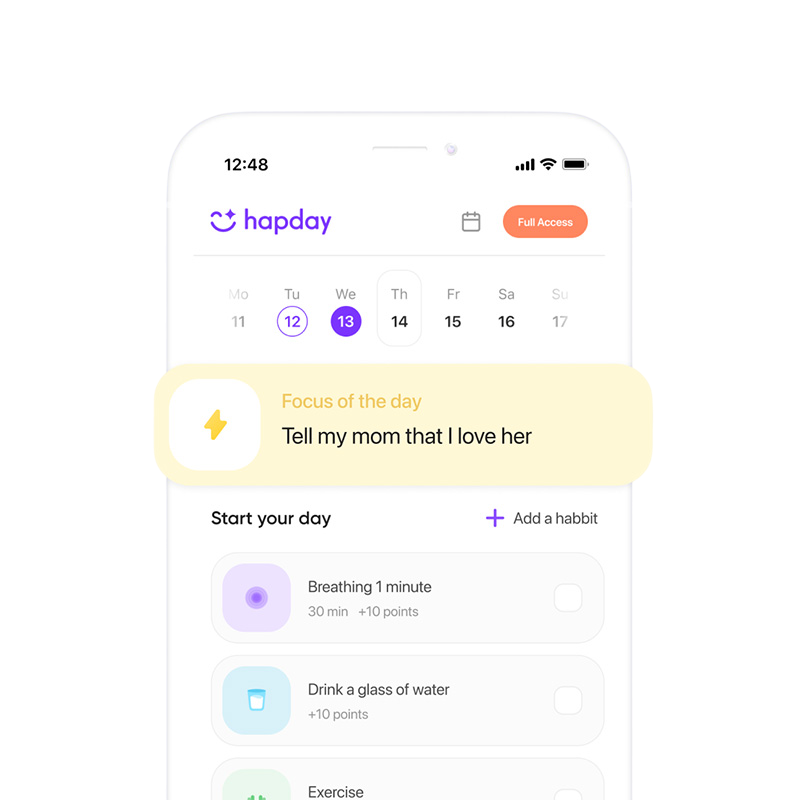
Build daily trust from the inside out with guided practices, coaching, and community. Start your inner child healing journey today at hapday.me — compassionate structure for real change.
The Bottom Line
Trust issues are often survival strategies learned in childhood. Inner child healing gives your nervous system new experiences of safety, helping you build self-trust and healthier relationships—one small, consistent step at a time.
References
- Centers for Disease Control and Prevention (CDC) – Adverse Childhood Experiences (ACEs) Fast Facts
- World Health Organization (WHO) – Violence against children
- Harvard Center on the Developing Child – Toxic Stress
- Mayo Clinic – Post-traumatic stress disorder (PTSD)
- National Institute of Mental Health (NIMH) – Any Anxiety Disorder
- Harvard Health Publishing – Relaxation techniques: Breath control helps quell the stress response
- American Psychological Association (APA) – Clinical Practice Guideline for the Treatment of PTSD in Adults
- National Institute of Mental Health (NIMH) – Psychotherapies